Connecting rigorous archival methodology with data science, AI, and 21st-century storytelling.
Education
- Master of Arts, History, Northwestern University, 2019
- Master of Arts, History, University of Oregon, 2017
- Bachelor of Arts, History, University of Texas-Austin, 2014
Bringing the Thomas Jackson Letters to the 21st Century
Narrative Auditing, Archival Research, & Digital Media Production
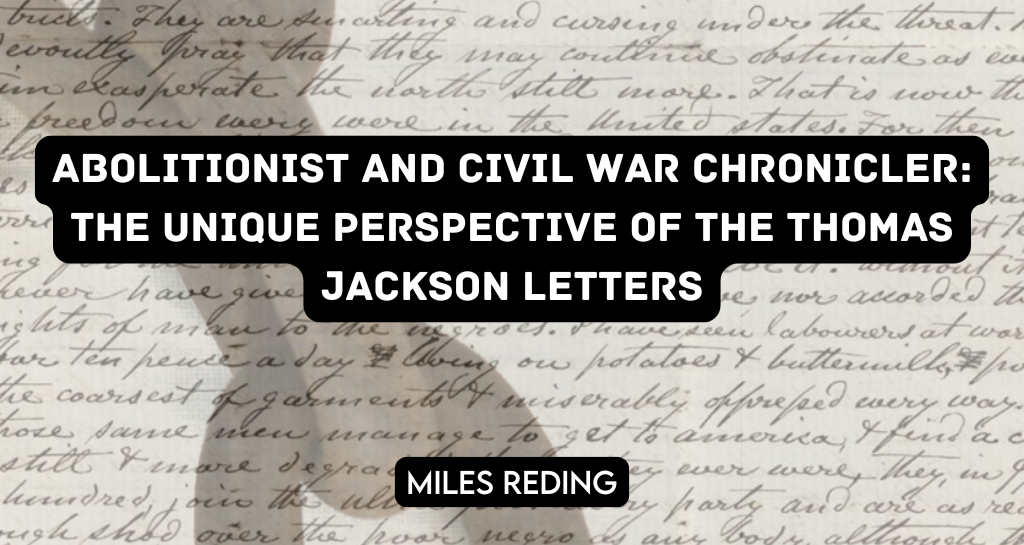
Thomas Jackson (1807–1878) was a British immigrant who built a prosperous rope-making business in Reading, Pennsylvania, and became a fierce grassroots abolitionist after witnessing the horrors of a Richmond, Virginia slave market. Unlike the Confederate general who shared his name, this Thomas Jackson left behind a sprawling collection of erudite letters and newspaper editorials that offer a rare, grassroots, transnational perspective on American slavery, the Civil War, and Reconstruction.
Operating as a Researcher & Writer for the Friends of Thomas Jackson (Dec. 2023 – Sep. 2025), my primary goal was to work alongside Jackson’s descendant and other team members to curate, verify, and promote this untapped archival collection to academic researchers and the broader public.
This project required careful methodological rigor in order to ingest fragmented, century-old manuscripts, verify their historical context, and synthesize them into compelling, factually grounded narratives—a foundational skill for corporate heritage preservation and historical data auditing.
Friends of Thomas Jackson
2023-2025
“Yesterday’s Colonization and Today’s Immigration”: An Intellectual Biography of Abdelmalek Sayad, 1957-1998
Archival Research and Longform Writing
This thesis provides an intellectual biography of the Algerian sociologist Abdelmalek Sayad, tracing the development of his ideas regarding Algerian immigration in postcolonial France. The research positions Sayad not merely as a scholar, but as a “scientific intellectual” who used the tools of social science—originally bestowed by colonizers—to dismantle and reconstruct a unique understanding of the colonized condition.
Methodological Approach
- Interdisciplinary Framework: The work sits at the intersection of two major historiographies: the history of immigration in postcolonial France and late-twentieth-century intellectual history.
- History of Ideas: It utilizes an “intellectual biography” approach to show how one individual’s writings can establish broader claims about colonial legacies and national identity.
- Humanized Sociology: Following Sayad’s own methodology (developed alongside his mentor, Pierre Bourdieu), the thesis emphasizes the value of direct dialogue and fieldwork to move beyond abstract data and uncover the lived reality of human suffering.
Key Theoretical Contributions
- The “Double Absence”: A central pillar of the thesis is the analysis of Sayad’s theory of “double absence”—the existential dilemma where a migrant is physically absent from their home country while remaining a perpetual “foreigner” or “Other” in the host society, leading to a profound crisis of identity and suffering.
- Neocolonial Critique of the Nation-State: The research highlights Sayad’s radical argument that modern migration is a continuation of colonial power structures. It explores how the logic of the nation-state is essentially exclusionary, viewing naturalization and integration as forms of “soft coercion” or “gentle violence”.
- The “Specific Intellectual”: The thesis contrasts Sayad with the “universal intellectual” (like Sartre or Zola), defining him as a “specific intellectual” who challenged power within defined institutional settings (academia) through scientific rigor rather than public polemics.
This work expands the understanding of immigrant engagement in France by showcasing the academic as a critical voice of resistance. It challenges the assumption that the social sciences ignored postcolonial studies until the late 1990s, proving that immigrants like Sayad were actively contesting dominant academic discourses decades earlier. This project serves as a foundational example of rigorous archival and sociological methods for addressing complex institutional and social challenges.
University of Oregon
2015-2017